|
|
Alongside the heavy mechanics of those huge operations the softer patterns of everyday life are everywhere to see: locals linger in parks longing for a breeze, the sticky streets ooze a laid back atmosphere, and the creativity that often comes hand in hand with a hardworking city is alive.
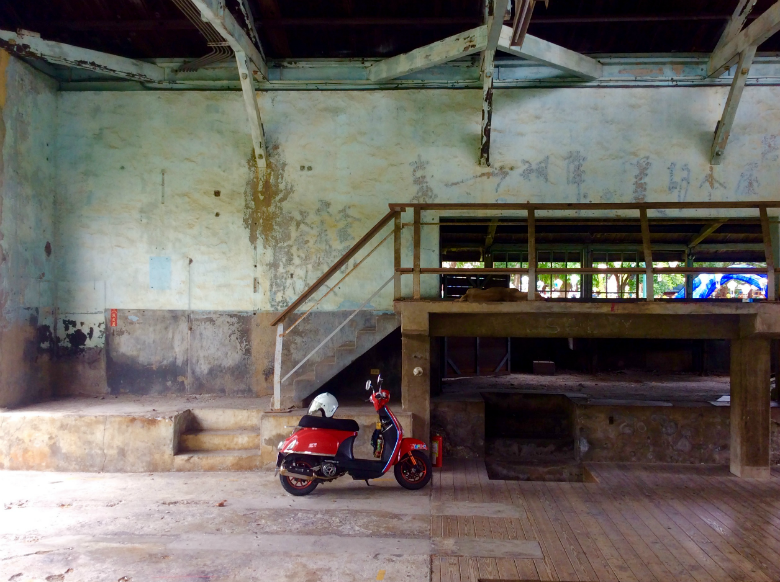
Born amongst the relics of the old port and its Japanese-built warehouses, a creative scene has awakened with wallfuls of graffiti, bright, bold and daring splashed across the sides of repurposed warehouses, historic walls alive with murals. Strange sculptures stand making statements, there’s a statue of Guan Yu holding a real-life mop instead of his trademark halberd and a raging bull with an equally raging demon-faced erection, parents chortling as they coax their children to pose for photos next to it. This is Pier-2 Art Center (新化里), a few minutes' walk south of Yanchengpu MRT.


 Full of cafes and exhibition spaces (see the official website for event listings and information) we browsed the surprisingly vast area infused with the creative vibe, paying particular time and attention to an all-in-one record shop, live venue and radio station, In Our Time, which was dedicated to releasing music from artists of aboriginal origin.

 Nextdoor to Pier-2 Art Center is Hamasen Railway Cultural Park and Takao Railway Museum, where old buildings and tracks like many tentacles spread out through an expanse of grass, parks and sculpture, remnants of the Japanese Hamasen railway now photo-ops, like one of the steam trains that used to traverse the line. This is just another example of what Taiwan does well: preserving the past and turning it into a place of leisure and play. Strangely there's another upside-down house plonked here, just as there is at Huashan 1912 Creative Park in Taipei.


 The regenerative art aesthetic and ideas of old into to new have also spilled into the streets surrounding Pier-2 and the Railway Parks, whose new trendy establishments are neighbours with machine-filled workshops and oily tinkers. Likewise, where the Instagram-friendly meets actual practical working lives, a stroll further along the port will bring interesting scenes of fisherman trying to catch dinner next to No Fishing signs and boat crews taking up various positions of chill on their docked vessels.

 Leading up and away from this area where the past meets practical present is a legitimate blast from history: the old British Consulate. It was at some point recently discovered that this was not in fact the consulate but rather the residence of those who worked at the consulate. So now it's Official Residence of British Consulate at Takow. It has its own website, if you're interested. It was built in 1865, and reflects a period of history in which the established nations of East Asia were being coerced to open up to trade with Western Powers. It was no different in Taiwan, then the territory of Qing Dynasty China; the 1860 Treaty of Peking forced open the ports of Tamsui (in what is now New Taipei City), An-ping in Tainan, Keelung, and of course Tak/ow/au/ao.
 We expected to be able to waltz in here for free and have a lovely cup of tea as us British do, but you have to pay like everyone else to get into this tourist attraction. We didn't pay, and instead rested our sweaty, sweaty bodies after walking all the way from Pier-2, ascending a steepish portion of backstreets and temple-strewn trail up the modest mountain atop which the Residence sits, Shoushan (壽山), watching the endless slow-moving nautical traffic coming in and out of Kaohsiung Port.
 Far from this, literally and figuratively, is the Lotus Pond (蓮池潭). This man-made lake, which opened in 1951, is touted as a major tourist attraction and we found it fascinating – not for its history, nor particular beauty, but for the strange structures surrounding the park, the genuinely old temples on its busy ring road, and for a glimpse into how an older slice of the local population spend their days, vagrant and idling, lounging in groups, gambling with cards, playing chess, staring at anything that walks by, and snoozing in almost impossible positions: our favourite was flat-out on the backs of scooters, legs dangling over handlebars.

 Slightly north of the pond, the Confucius Temple (孔廟) does offer a peek into the history and mystery of Confucianism with its ceremonies and musical instruments explained briefly thanks to a smattering of good English signage. For those with a penchant for days past it's an interesting wander, constructed as it was in 1684. It's the logical starting point for a loop of the pond if, like us, you decide to trudge by foot from the nearest MRT station, Zuoying, instead of getting a shuttle bus like a normal person.


 The shore itself is lined with different sections of parkland, monuments, and various temples and shrines, gaudy and interesting. We circumnavigated the pond anti-clockwise. One of the first things you see, because it's hard to miss, is the giant, red-faced Xuan Tian Shang Di statue (玄天上帝神像), a Taoist deity, presiding over the pond, 72-metres tall, at the Pei Chi Pavilion (北極亭), built between 1991 and 1995.
 We found a more interactive monument a little further round, where we ran childlike through the long belly of a dragon at the Spring and Autumn Pavilions (1976), emerging into the bright light of the world from its rear end, more like something from an amusement park than anything spiritual. It is wholly spiritual, however: a depiction of Guanyin Riding A Dragon (觀音騎龍像), a sort of Taoist-Buddhist crossover, in that Guanyin is the representation of the bodhisattva of compassion.


 You can once again embark on an internal journey through another dragon, and a tiger, at the the southern end of the lake thanks to another temple, the Dragon And Tiger Pagodas (龍虎塔) (1953)—you go in through the former, out through the latter for good luck.

 Whilst all set for tourism, with all the statuary and bridges over to islands and edifices built over the glassy water, as well as older temples dotting the outskirts, the park is decidedly rough (for instance, we stepped on a dead rat), but it’s an interesting way to spend a couple of hours, especially if you like people-watching or pagodas and traditional Chinese religion.
 From one body of water to the next: Love River (愛河) is the sugary name given to what apparently used to be an open sewer. A bit of cleaning up and a polish has made the area pleasant for a stroll in the evening, if strolling's your game. Gondalas festooned with strings of lights pass by, a karaoke bar at the edge of 228 Memorial Park blares romantic classics out into the promenade, and in the park itself people practice Falun Gong – more popularly known as Falun Dafa in Taiwan – perfectly accented with the sweet smell of evening flowers. We enjoyed this dreamy, gentle atmosphere.
 Taiwan's second city lives in the shadow of the northern capital; despite being an important centre for trade and politics with its own metro system and the second largest mall in Asia it is sleepier with less evidence of affluence. The city can however pull its own weight being the bustling port that it is, having historical global credentials and the infrastructure of a world city—enough to’ve hosted the World Games 2009. Driven between Kaohuing's sluggish somnolence and dogged industriousness is a fat wedge of excitement comprising zings of creativity and youthful abandon, a lust for the future and a space in which to create it at the feet of a growing forest of skyscrapers and highrises. Taiwan’s tomorrow is under construction in the deep south.

|
Important distinction: this market got its name because tour groups began stopping off here, probably for being an easily navigable one street, not because it was made for tourists, so don’t worry about that. And don’t believe the bad hype you read online, it’s alright really. 
 For those with no dietary limitations, carnivores of the first degree, it's a treasury of taste. For vegetarians there aren’t a great deal of options, but the deep fried mushrooms are wonderful. Crunchy, juicy, golden snacks with none of the slimy, slug-like-ness associated with mushrooms. Served up in a cardboard cup by a lady with a friendly face who was happy to chat (though neither of us fully understood each other).

 Then there’s the wholly not-vegetarian pig’s blood cake (豬血糕). It's chewy, it's salty, it's warm, and not as blood-flavoured as the more intense black pudding of the U.K. or rich boudin noir from France. Described by the Taiwanese adopted character 'Q' meaning 'bouncy', it's more rice cake than offal. Spicy or non-spicy available. Night market staple.

 A pork bun also made its way into our mouths. This is no char siu bao: it's a 胡椒餅 (hújiāo bǐng) or pepper bun, originally from Fuzhou Province, Mainland China, and super popular all over Taiwan. To describe it, well, it's akin to a Cornish pasty with Chinese flavours: a melty but firm minced pork and green onions mixture in a slightly glazed shortbread-y casing topped with sesame seeds. It's a snack and a half. Watch out for its porky oil that leaks out everywhere after the first bite.

🌯 Rueifeng Night Market (瑞豐夜市) There are countless food stalls here: rows upon rows of how-can-we-choose and that-looks-amazing turned this into a huge operation for us. We sweated and wandered and sweated some more as locals came and went, swiftly honing in on their snack of choice and zipping off into the night on their scooters. Clothes stalls, with a decent sense of style, dominated in some parts; mahjong, ancient pachinko and other games also made many appearances. It’s busy and we loved it.
The green onion pancake (葱油饼) is famous stuff, here no less than anywhere. Layers of batter mixed with green onion to make a fluffy, chewy, nicely greasy wrap stuffed with a filling of your choice. We went for one smothered with egg, and one with pork floss—that's pork, of course; it looks like ground-up fibre glass, but it's sweet and inexplicably peanuty with a unique candy-floss texture. Would eat again right here right now.
🍕 Cafe Grazie (義式屋古拉爵) Spoilt with options for dinner at Taiwan's biggest mall, take a step aside from the crowds at the food court on B1 and try out this oshare but reasonably priced Italian restaurant. The vegetable pizza comes with a good selection of fresh toppings and the pesto and sausage pizza is loaded with a garden of rocket, the thin golden base showed this isn't just an idiosyncratic interpretation of a pizza, but simply good and tasty pizza. If you go to Dream Mall (夢時代) to check out Asia's second largest shopping complex and you are feeling peckish this is an easy, satisfying option. The red wine is good too, weirdly refreshing since it’s served cold – as is usual is East Asia.  Dream Mall is located around a ten-minute walk from Kaisyuan MRT station. A light railway is planned and scheduled to open mid-2017, however, and by the looks of things there's a stop right on the threshold of the mall.

THINGS THAT ARE NOT SO TASTY / HYPEFRAUD
❌ Kaisyuan Night Market (凱旋觀光夜市) |


accommodation